
How Control Overlap Between ISO 27001, SOC 2 and DORA Reduces Your Total Evidence Burden
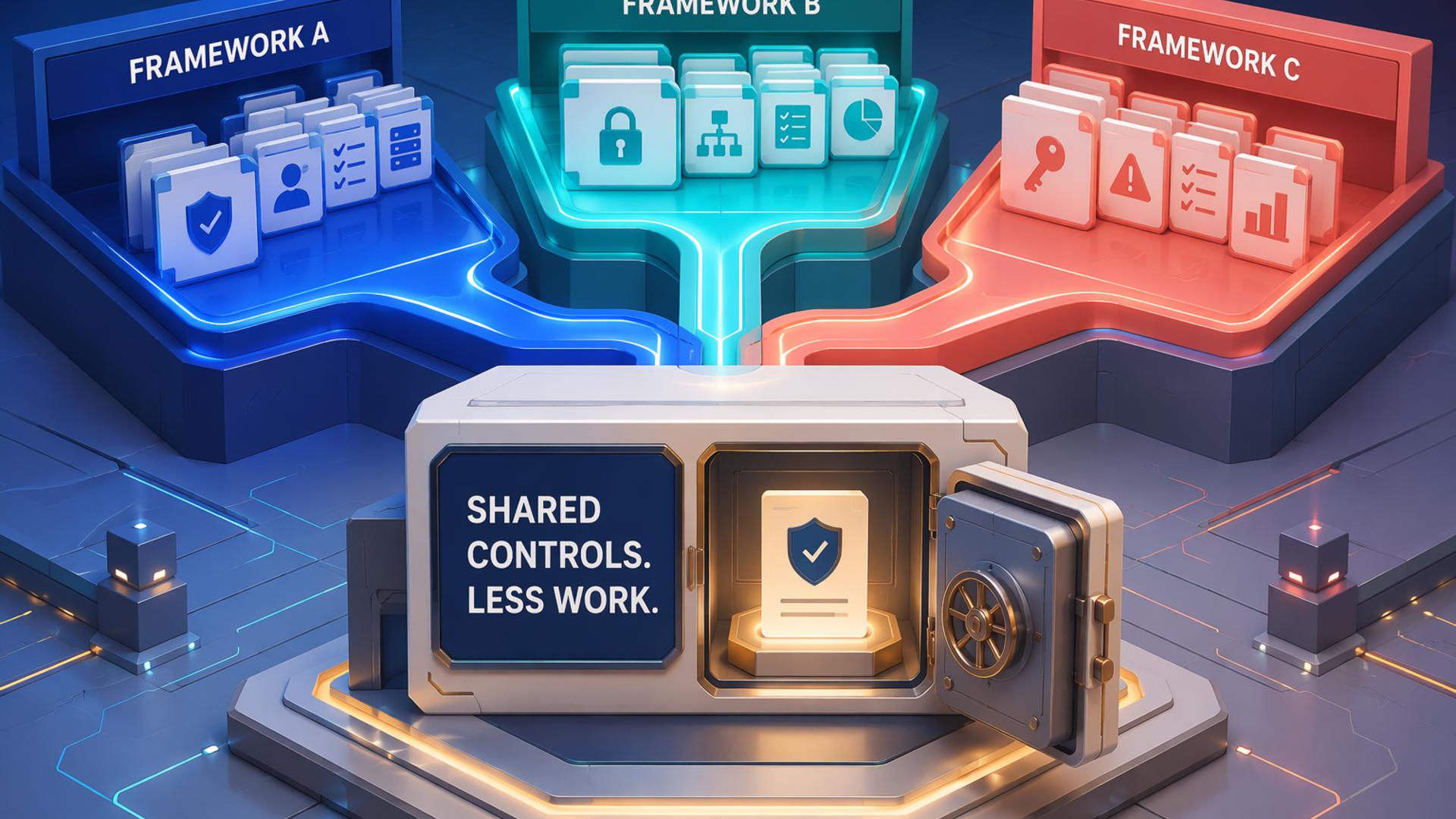
If you're managing ISO 27001, SOC 2, and DORA simultaneously, you're probably collecting evidence three times for controls that are nearly identical. That's not a compliance requirement; it's a workflow problem. The three frameworks share far more common ground than most compliance teams realize, and that overlap is where your biggest efficiency gains are hiding.
Why ISO 27001, SOC 2, and DORA Feel Like Three Separate Audits
If you're managing ISO 27001, SOC 2, and DORA at the same time, they often appear to function as three separate audits, even though their underlying control intent overlaps significantly, typically in the range of 80–96% across areas such as governance, access control, incident response, and monitoring. The main source of friction isn't the controls themselves but how each framework structures, scopes, and evidences those controls.
ISO 27001 focuses on certifying your Information Security Management System (ISMS) and requires a formal Statement of Applicability that documents which Annex A controls are in scope and how they're implemented. SOC 2, by contrast, is an attestation over a defined system and period (usually 3–12 months), emphasizing the operating effectiveness of controls as they relate to the Trust Services Criteria. DORA introduces additional requirements specific to the EU financial sector, including mandatory resilience testing, defined timelines for incident reporting, and more prescriptive oversight of ICT third-party providers.
Because each framework has different scoping conventions, evidence expectations, and reporting formats (e.g., ISO certification vs. SOC 2 attestation report vs. DORA regulatory compliance), organizations often end up preparing separate documentation sets and audit activities. This can make a largely shared control environment appear as three distinct compliance efforts, even though a consolidated control framework and common evidence base can often support all three with targeted adaptations.
The Core Controls All Three Frameworks Actually Require
Despite structural differences, ISO 27001, SOC 2, and DORA rely on a shared set of foundational controls that most mature organizations already address: risk governance, access control, incident response, monitoring, and continuous improvement.
ISO 27001’s risk treatment process and Statement of Applicability (Clause 6.1) align closely with SOC 2 criteria CC3.0 and CC9.1, as well as DORA Articles 5 and 6 on ICT risk management.
Access control requirements in ISO 27001 Annex A correspond to SOC 2 criteria CC6.1–CC6.3 and DORA Article 9.
Incident management provisions in controls A.5.24–A.5.28 support SOC 2 CC7.3 and CC7.4 and are consistent with DORA Articles 17–22 on incident reporting and management.
Logging and monitoring controls A.8.15 and A.8.17 align with SOC 2 criteria CC7.1 and CC7.2 and DORA Article 10.
In practice, these overlaps cover the majority of required controls, allowing organizations to implement a largely unified control set and apply it across all three frameworks with targeted adjustments.
Access Control, Incident Response, and Monitoring: Your Highest-Overlap Zones
Access control, incident response, and monitoring are the most efficient domains for building a unified evidence strategy across ISO 27001, SOC 2, and DORA because they share a high degree of control overlap.
For access control, ISO 27001 controls A.5.15–A.5.18 and A.8.1–A.8.5 align closely with SOC 2 CC6.1–CC6.3 and DORA Article 9. In practice, a single set of IAM policies and periodic access review records can be used as common evidence for all three frameworks, provided they're implemented and documented consistently.
Incident response requirements are also highly convergent. ISO 27001 A.5.24–A.5.28, SOC 2 CC7.3–CC7.4, and DORA Articles 17–22 all emphasize defined procedures, clear roles, timely detection, communication, and post-incident review. While the exact percentage of overlap will vary by implementation, most organizations can support these requirements with one integrated incident response plan, complemented by incident tickets and post-incident reports.
Monitoring controls similarly lend themselves to reuse. Standard logging configurations, SIEM alerts, and anomaly detection records typically satisfy ISO 27001 A.8.15 and A.8.17, SOC 2 CC7.1–CC7.2, and DORA Article 10. By tagging each monitoring artifact with the relevant control identifiers once—across all three frameworks—organizations can reduce duplicate documentation effort and maintain a more consistent evidence set.
Which Evidence Artifacts Satisfy ISO 27001, SOC 2, and DORA Simultaneously
Because ISO 27001, SOC 2, and DORA share substantial control overlap, you can build a unified control library where a single set of evidence artifacts supports multiple frameworks.
For example, IAM logs, access reviews, and joiner/mover/leaver records can collectively cover ISO 27001 controls A.5.15–A.5.18, SOC 2 criteria CC6.1–CC6.3, and DORA Article 9.
A consolidated risk register that includes risk assessments, treatment plans, and key risk indicators (KRIs) can address ISO 27001 Clause 6.1, SOC 2 CC3.0, and DORA Articles 5–6.
Similarly, incident tickets and post-incident reviews can satisfy ISO 27001 controls A.5.24–A.5.28 and SOC 2 CC7.3–CC7.4, and by incorporating DORA-specific fields for classification, impact, and reporting timelines, the same underlying evidence can also meet DORA Articles 17–22 without creating separate, duplicative records.
Build Once, Map Three Times: The Unified Control Library
Knowing which artifacts satisfy multiple frameworks simultaneously is only part of the work; you also need a structure that makes reuse deliberate and repeatable.
A unified control library gives each control a single owner, review cadence, and performance threshold, then maps that control to ISO 27001, SOC 2, and DORA requirements in parallel.
Using control mapping software can make this unified library operational by connecting each internal control to the applicable ISO 27001, SOC 2, and DORA requirements in one place. That makes shared evidence easier to reuse while clearly surfacing the framework-specific gaps that still need attention.
In practice, it's effective to begin with domains that show the highest degree of overlap—such as governance, risk management, incident response, and monitoring—where alignment often reaches 85–90%.
ISO 27001 can serve as the primary structural framework, with each control linked to corresponding SOC 2 trust services criteria and DORA articles.
DORA-specific requirements, such as those related to Threat-Led Penetration Testing (TLPT), are then added as incremental layers, minimizing duplication and reducing the need to reconstruct existing controls.
The DORA Delta: The 20–30% No Existing Program Covers
Even with a mature ISO 27001 framework and significant SOC 2 alignment, DORA introduces an additional 20–30% of requirements that are typically not addressed by existing programs.
This gap centers on four areas: (1) mandatory regulatory incident reporting with specific timelines, formats, and data fields; (2) threat-led penetration testing (TLPT) and scenario-based operational resilience exercises; (3) a formal register of ICT third-party providers, including contractual flow-down clauses and defined exit and substitution strategies; and (4) clearer and more explicit board-level accountability for ICT risk and resilience.
These elements represent distinct, prescriptive obligations rather than incremental interpretations of existing controls.
Evidence from recent industry assessments indicates that only a small proportion of financial institutions—around 8%—currently meet DORA’s full resilience testing expectations, suggesting that most existing compliance programs will require targeted enhancement to close this gap.
How Much Duplication a Unified Compliance Program Actually Eliminates
When you map controls once across ISO 27001, SOC 2, and DORA, organizations commonly reduce duplicated evidence collection by approximately 40–60%. In practice, the same access reviews, incident records, and risk registers can be used to satisfy requirements across all three frameworks.
Control overlap is highest in areas such as risk management (around 90%), access control (around 85%), and monitoring/logging (around 85%). This allows teams to rely on shared evidence sets rather than maintaining separate trackers for each framework.
Because roughly 80% of SOC 2 criteria align directly with ISO 27001 controls, the primary work often involves adapting how evidence is presented to different auditors and regulators rather than redesigning controls from scratch.
The 12-Month Sequence That Cuts Your Total Compliance Effort
Sequencing certification efforts within a 12‑month cycle allows you to develop a single, integrated security and compliance program instead of managing separate, overlapping projects. In months one through six, you implement your Information Security Management System (ISMS) and pursue ISO 27001 certification.
The resulting control framework generally aligns with a substantial portion of SOC 2 requirements, so a significant share of SOC 2 criteria can be addressed using existing ISO 27001 documentation, controls, and processes.
From months seven through nine, the focus shifts to SOC 2 Type II. At this stage, most work centers on collecting evidence of operating effectiveness over time rather than designing and implementing new controls.
This includes gathering system logs, policy attestation records, access reviews, and other operational artifacts that demonstrate controls are functioning as intended.
In months ten through twelve, you address the remaining requirements specific to the Digital Operational Resilience Act (DORA). Typical additions include threat-led penetration testing (TLPT) where applicable, updating third‑party contracts with required resilience and reporting clauses, and aligning incident reporting procedures and timelines with regulatory expectations.
The Real Cost of Running ISO 27001, SOC 2, and DORA as Separate Programs
Running ISO 27001, SOC 2, and DORA as separate programs typically results in recreating similar governance, access control, incident response, and monitoring evidence multiple times, even though an estimated 70–90% of underlying controls overlap across the three frameworks.
SOC 2’s requirement to demonstrate operating effectiveness over a defined review period often leads to recurring documentation cycles.
ISO 27001 introduces additional, framework-specific artifacts such as the Statement of Applicability and structured internal audit records.
DORA adds time-bound incident reporting obligations and resilience testing activities that can parallel existing security and continuity measures.
This fragmentation can increase compliance costs and operational effort.
Industry analyses indicate that DORA implementation alone can require investments in the range of €2–5 million for larger or more complex organizations, while only a small proportion report full readiness ahead of enforcement deadlines.
By consolidating these frameworks into an integrated compliance program—using a single control set, shared evidence repository, and coordinated testing and audit cycles—organizations can reduce duplicated work.
In practice, this integrated approach can lower redundant effort associated with overlapping controls by an estimated 40–60%, depending on the organization’s size, complexity, and existing governance structure.
Conclusion
When you treat ISO 27001, SOC 2, and DORA as one integrated program instead of three separate audits, you cut your evidence burden by 40–60% and stop rebuilding the same documentation from scratch. You map your controls once, reuse your artifacts across frameworks, and focus your energy on the genuine DORA delta. The cost of running parallel programs isn't just inefficiency—it's risk. A unified approach eliminates both.